
Surprising fact: one indie author self-published 40+ titles since 2014 and now pulls in about $1,500–$2,000 per month. That result came from testing, research, and steady action—not luck.
This guide shows a clear plan to get started with an ebook side hustle that uses AI for research, outlining, drafting, and formatting. Writing is only one step. Turning a book into income needs a repeatable system for topic selection, production, publishing, and promotion in the digital world.
Practical promise: you will see every path to Earn Money by Writing eBooks—from self-publishing to working as a ghostwriter for hire. Expect tips on validating demand, outlining chapters, designing covers, picking platforms, and building blog and email funnels that sustain sales.
Why writing ebooks is a smart way to make money right now
Writing short, focused ebooks is one of the fastest ways to turn expertise into ongoing sales in today’s digital market.
Passive income works because you invest time up front to create a product, systems, and promotion. Once live, an ebook can keep selling with small updates and occasional marketing pushes.

Passive income potential in the current ebook market
The global ebook market is roughly $14.9 billion this year and is growing about 3.92% annually through 2028. Over a billion readers use ebooks, so demand is real.
How AI accelerates writing, design, and publishing workflows
AI cuts research and drafting time. Use tools to summarize sources, suggest titles, map chapters, and format draft sections. That frees time for positioning, pricing, and promotion.
- Business mindset: treat ebooks like products—position, price, and promote.
- Distribution: social media plus owned media (site, email) amplifies reach and lowers launch risk.
- Compounding: one solid ebook speeds future sales, cross-sells, and credibility for authors.
| Benefit | Why it matters | Quick action |
|---|---|---|
| Evergreen sales | Continued revenue with periodic updates | Choose practical, solution-focused topics |
| Faster production | AI reduces research and draft time | Use AI for outlines and formatting |
| Lower launch risk | Test hooks on social and email first | Validate with short landing pages |
You’ve got a growing market, proven platforms, and AI to help—now is a great way to act and make money writing ebooks systematically.
Understanding ebooks today: formats, devices, and reader expectations
Formats shape how readers consume your ebook. Pick a file type that fits the content, devices, and distribution channel you plan to use.
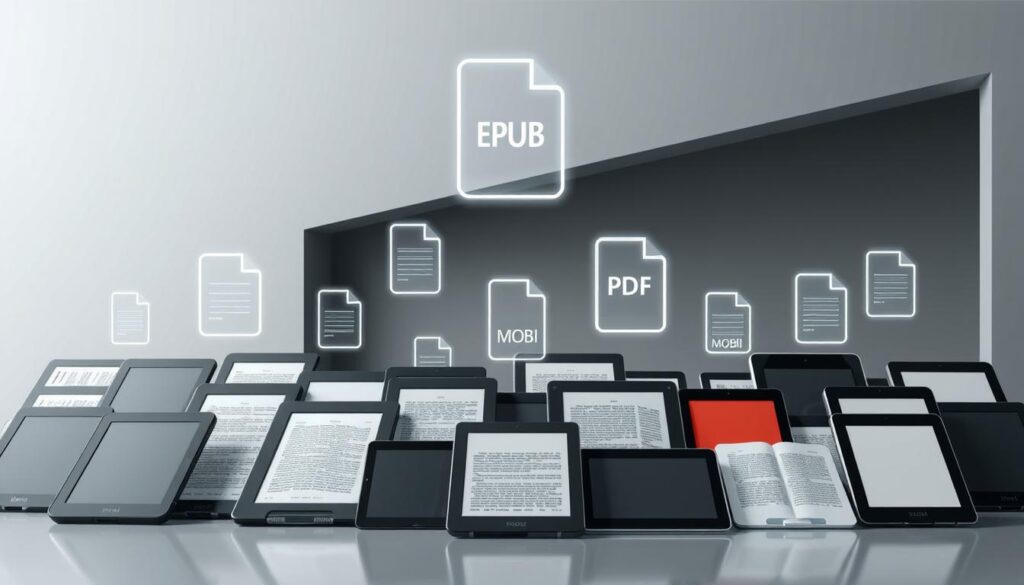
Common file types explained
Printable PDF: easy to create and perfect for fixed-layout workbooks, handouts, or templates where each page matters.
Interactive PDF: adds links, navigation, and fillable fields for guided courses and sheets.
HTML5: supports multimedia, animations, and live links—best for immersive learning experiences shared via web pages.
EPUB: the responsive standard used by major retailers and e-readers; it adapts typography and reflows pages for small screens.
Choosing the right format
- Use EPUB for bookstore distribution and device compatibility.
- Choose HTML5 for interactive lessons or embedded media.
- Offer a printable PDF when fixed pages or templates matter to the reader.
| Intent | Best Format | Why |
|---|---|---|
| Retail sales | EPUB | Responsive, accepted by stores and e-readers |
| Workbooks/templates | Printable PDF | Fixed pages preserve layout and design |
| Interactive learning | HTML5/Interactive PDF | Multimedia and navigation improve engagement |
Production tip: draft in a word processor, layout in a design tool, then export to EPUB and PDF. Test with previewers and include clear metadata—title, subtitle, author, and keywords—to boost discoverability and sales.
Choose a profitable niche and validate demand before you write
Before you draft, lock in a market and validate that people will pay for your idea. Picking the right niche reduces risk and raises the chance your ebook will earn steady sales.

Spotting evergreen topics and trending genres that sell
Start with proven categories: self-help, health/fitness, finance, productivity, romance, and thrillers. Nonfiction that solves a specific problem often outperforms general advice.
Keyword, audience, and competitor checks to reduce risk
Do quick demand checks: keyword research plus marketplace scans on Amazon for rankings and reviews. Confirm that people search for and buy similar ebooks.
Evaluate competition quality: look for books that are short, outdated, or missing clear steps your expert lens can add. That gap is your opportunity.
- Refine your idea into a clear promise and measurable outcome.
- Profile your audience: pain points, format preference, price tolerance, and where they hang out online.
- Estimate market size vs. differentiation and plan cross-sells or bundles to build a small business around the topic.
- Pre-validate with surveys, waitlists, or content teasers to gauge interest before full production.
Plan your book: outline, word count, and structure that sells
Map the reader’s journey first: an outcome-focused outline turns ideas into a usable book structure. Start by listing the end result and split it into clear chapters.
Pages, chapters, and steps:
- Match each chapter to one outcome, then break chapters into numbered steps and short subheadings.
- Set target words and pages: 12,000–25,000 words works for concise guides; increase length only if every page adds value.
- Time-box writing sprints so drafts move fast without losing your voice.

Using AI to expand outlines and draft chapters faster
Use AI to brainstorm titles, generate chapter talking points, and suggest examples or case study slots. Combine AI first drafts with focused edits to keep authenticity.
| Plan element | Target | Action |
|---|---|---|
| Outline | Chapter → outcome | Map 6–12 chapters, list steps per chapter |
| Length | 12k–25k words | Set page targets and track words per page |
| Conversion | Checklists & templates | Place worksheets where readers apply steps |
Keep a living doc of sources and images. Align chapter transitions with your business offers but keep reader trust first. This structure makes it faster to write an ebook that sells.
Write with AI, edit like a pro: creating high-value content
Let AI handle the heavy lifting so you can shape ideas into a polished, sale-ready book faster.

Prompting AI for research, summaries, and first drafts
Use targeted prompts for topic outlines, section summaries, and alternative phrasing. Treat AI output as a draft—never the final text.
Create a prompt library for repeat tasks: chapter synopses, example generation, and FAQ drafts. That saves time across projects and keeps your workflow consistent.
Human editing for voice, accuracy, and originality
Establish an editing checklist: verify facts, tighten sentences, and add expert nuance.
Layer in personal stories and original frameworks so the reader sees your experience. Run originality and citation checks and rephrase any generic passages.
Adding worksheets, templates, and case studies for extra value
Include worksheets, templates, case studies, and checklists to boost perceived value and help readers act fast. These extras justify higher pricing and improve the user experience.
- Preserve your voice: personal anecdotes and real examples.
- Publishing readiness: consistent headings, alt text, and a full table of contents.
- Track time per chapter and refine prompts to speed the next create ebook cycle.
| Step | Action | Benefit |
|---|---|---|
| Prompt library | Save templates for recurring tasks | Faster drafts and consistent output |
| Editing checklist | Fact-check, tighten, align tone | Professional, trustworthy book |
| Value add | Worksheets & cases | Higher conversions and better reviews |
Design that converts: ebook cover and interior layout
Cover and interior design shape a reader’s first impression and the buying decision. A clear thumbnail cover gets attention. Clean pages keep readers engaged and improve reviews.

Cover design best practices that boost clicks and sales
Prioritize an eye-catching ebook cover that reads at thumbnail size. Use bold typography, high contrast, and imagery that signals genre and promise.
- Hierarchy: title first, subtitle second, author name subtle.
- Limit colors: two to three tones keeps the design readable.
- Negative space: gives the cover room to breathe and improves clicks.
- Budget smartly: a strong cover often increases conversion more than other tweaks.
Tools and templates to create ebook interiors quickly
Use templates to speed layout. Visme offers customizable ebook templates, AI-assisted design, stock images, dynamic fields, and collaboration tools.
Keep interior readability high: generous line spacing, consistent headers, and scannable callouts. Test page rendering on phone and tablet screens.
| Feature | Why it helps | Quick action |
|---|---|---|
| Templates | Speeds consistent layouts across pages | Use Visme multipage designs |
| Interactive media | Boosts engagement for HTML5 books | Add links and embeds sparingly |
| Export options | Print or digital-ready files | Export PDFs with bleed or LMS formats like xAPI/SCORM |
Balance brand and usability. Align fonts and colors with your style, but respect contrast and font-size rules for a better reader experience. A small bit of interactivity helps in some formats; keep PDF versions lean and readable.
Publish like an author: where to sell ebooks for maximum reach
Choose distribution channels that match your goals: wide reach, direct control, or a mix of both. Each path affects royalties, fees, and the time it takes for your book to appear in stores.

Amazon KDP basics: upload, preview, and promotional tools
Start on Amazon KDP for the largest audience. KDP accepts DOCX, EPUB, and KPF. Use the previewer to check formatting across devices before you publish.
Royalty note: KDP offers 70% or 35% royalties. The 70% option applies in specific territories and includes delivery fees (roughly $0.06 per unit, varying by file size).
Wide distribution: Smashwords, Draft2Digital, and Rakuten Kobo
Aggregators extend reach to Apple Books, B&N, Kobo, and libraries. Smashwords pays ~60% of list price to authors and ~45% for library sales. Draft2Digital takes about 10% of the list price, leaving roughly 60% for authors after retailer cuts. Kobo offers direct uploads and OverDrive library options, with a CAD $50 minimum payout.
Direct sales platforms: Gumroad, Payhip, Sellfy
Selling directly gives control over pricing, discounts, and customer data. Gumroad charges ~10% per sale and handles delivery. Payhip’s free plan takes 5% per transaction. Sellfy uses subscription plans and provides a simple storefront.
| Channel | Fees/Royalties | Best for | Notes |
|---|---|---|---|
| Amazon KDP | 70% / 35% (delivery fees on 70%) | Mass reach, promotions | Use previewer; enable Kindle deals |
| Draft2Digital | ~10% aggregator cut | Wide distribution, easy setup | Most stores take ~30%, author ~60% |
| Smashwords | ~40% cut for distributors (author ~60%) | Apple, B&N, libraries | Distribution can be slower |
| Gumroad / Payhip | ~10% / 5% (free plan) | Direct sales, audience control | Flexible pricing, coupons, instant delivery |
Quick steps: prepare metadata, upload a strong ebook cover, test listings, and note each platform’s payout timing to smooth your cash flow. Small setup time yields ongoing sales if you optimize price, page copy, and distribution mix.
Pricing strategies and royalties that make sense
Price signals quality: choose a price that matches reader expectations and the value you deliver. A clear price helps shoppers decide fast and supports steady income over time.
Positioning by niche, length, and value
Benchmark similar titles in your niche to find the common price band. Align your list price with depth and practical outcomes rather than just word count.
Short playbooks that solve one problem can command a premium if they include templates, worksheets, or case studies.
Understanding royalties and delivery fees
On Amazon KDP, the 70% royalty applies when your price is $2.99–$9.99 in eligible territories. Delivery fees (often about $0.06 per unit) reduce the final payout.
Outside that range or in other regions, the royalty is 35%. Aggregators like Draft2Digital typically leave authors with roughly 60% after retailer cuts.
- Test charm pricing and bundles to lift average order value.
- Track conversion at each price and iterate.
- Factor refunds, VAT/GST, and file-size delivery fees into your income plan.
| Scenario | Typical net | When to use |
|---|---|---|
| Amazon 70% | ~70% minus delivery fee | Price $2.99–$9.99; large audience |
| Amazon 35% | 35% | Outside price window or unsupported region |
| Aggregator (Draft2Digital) | ~60% after cuts | Wide distribution to stores and libraries |
| Direct sales | ~80–95% (platform fees vary) | Higher margins, needs promotion |
Build your sales engine: landing pages, blog posts, and email
Build a focused sales funnel that turns curious readers into paying customers for your ebook. Start with a single conversion page that states the promise, shows social proof, and offers a clear call to action.
High-converting landing pages and calls to action
Use a benefit-led headline, a short overview, and bulletproof FAQs to remove objections. Add a low-friction checkout and a visible guarantee to lower risk and lift sales.
Map related pages around this primary page: discovery posts, an FAQ, and a thank-you page that presents cross-sells or bundles.
List building with lead magnets and nurturing sequences
Create lead magnets—sample chapters, checklists, or worksheets—to grow your list. Send a short email sequence that includes step-by-step CTAs guiding readers toward purchase.
- Promote across social media with short videos and carousels that answer top objections.
- Repurpose blog posts into threads and emails to keep messaging consistent across media.
- Track views, clicks, opt-ins, and purchases to prioritize what improves conversion.
| Funnel area | Primary goal | Quick action |
|---|---|---|
| Landing page | Convert visitors | Benefit headline, proof, one-click checkout |
| Blog posts | Drive discovery | SEO posts that link to the main page |
| Email sequence | Nurture leads | 3–5 helpful messages with a clear step CTA |
| Social media | Awareness & traffic | Native posts, reels, and paid boosts |
Promote your ebook: social media, collaborations, and reviews
Promotion is the bridge between a finished ebook and the people who will buy it. A launch that looks like an event brings attention quickly, while a steady evergreen plan keeps sales alive over months.
Social media tactics for launches and evergreen sales
Schedule a week of social media content that blends short lessons, behind-the-scenes clips, and clear outcome-driven proof. Treat the launch like a mini campaign: countdown posts, sample excerpts, and a live Q&A.
Partner with creators in your niche for shoutouts, joint lives, or newsletter swaps to expand reach. Repurpose blog posts into threads and short videos that link back to your sales pages and retailer listings.
Collecting and showcasing reviews to drive credibility
Offer advance copies to your list and peers to gather early reviews. Reviews on Amazon and Goodreads strongly influence buying decisions, so display top quotes on landing pages and storefronts.
Run limited-time price promotions to re-ignite algorithms and collect more feedback, then return to standard pricing. Track performance with UTM links and platform codes so you can see which posts actually drive sales.
- Launch cadence: schedule educational posts, proof, and live events for one week.
- Collaborations: swap newsletters, do joint lives, and ask for influencer mentions.
- Review strategy: give ARCs, ask honest reviewers, and highlight best quotes.
- Evergreen: rotate tips, success stories, and short CTAs to avoid audience fatigue.
- Measure: use UTM tracking and respond to comments and DMs quickly to boost conversions.
Earn Money by Writing eBooks: step-by-step launch plan
Follow a compact workflow that blends validation, AI drafting, and promotion to reach your first sale. This plan keeps tasks small and measurable so you can get started without overwhelm.
From idea to first sale: a practical workflow with AI support
- Validate: quick keyword checks, competitor scans, and a short survey; capture interest with a waitlist.
- Outline: draft chapter bullets, then use AI to expand examples; set milestones and dates.
- Draft: run AI-assisted first drafts; edit for voice and originality; add worksheets and templates.
- Design: create cover and interior; export EPUB/PDF and test on previewers and devices. Quick fixes save time.
- Price & upload: set a competitive price, craft product copy, and publish to KDP or aggregators.
- Launch funnel: build a landing page, email sequence, and social posts; schedule a focused week-one push.
- Monitor: track early sales, gather reviews, and answer FAQs promptly.
- Iterate: tweak price, landing page, and promos; lock a weekly promo rhythm to sustain sales.
Timeline, milestones, and checklists to stay on track
| Phase | Goal | Time |
|---|---|---|
| Validate | Confirm demand & waitlist | 1 week |
| Produce | Draft + edit + design | 2–4 weeks |
| Launch | First sales & reviews | 1 week |
Optimize for more income: tracking, updates, and new formats
A continuous optimization loop turns occasional sales into predictable income for your ebook titles. Use basic analytics to see where readers engage, where they drop off, and which channels deliver the most buyers.
Analytics to monitor sales, read time, and traffic sources
Track sales by channel, conversion by page, and average time spent on key sections. Platforms like Visme show unique visits, average time, downloads, and completion rates.
Marketplaces such as Amazon provide sales dashboards. Gumroad handles VAT/GST by buyer location, which simplifies taxes for direct sales.
Updating content, bundles, audiobooks, and print-on-demand
Schedule updates: refresh examples, fix outdated stats, and re-export files. Notify buyers when you publish updates to encourage repeat engagement.
Expand your product stack with bundles, companion workbooks, audiobooks, and print-on-demand editions to serve more reader preferences and lift average income.
- Test formats: EPUB, PDF, and HTML5 to compare completion rates and support queries.
- Refresh assets: update covers and descriptions seasonally to match current demand in the market.
- Loop: track, update, relaunch mini-promos, and document learnings for the next ebook.
Alternate path to income: make money as an ebook ghostwriter
Ghostwriting lets you write under another name while charging expert rates and avoiding most self-promotion. A ghostwriter delivers a finished manuscript; the client gets the byline and the publishing pipeline.
What ghostwriting is and how to find quality clients
Clients range from entrepreneurs to busy authors and businesses publishing lead magnets or short books.
Good sources include Upwork, The Write Life job board, Freelance Writing, and Funds for Writers. Filter listings by budget and niche to avoid low-paying gigs.
Rates, deals, and setting expectations for deliverables
Typical deals include flat fees, advances (large projects can reach $10,000+), royalty splits, or a mix with rush premiums.
Set clear terms up front: scope, rounds of edits, timeline, deposit schedule, and confidentiality.
- Position as an expert: showcase niche experience, testimonials, and anonymized samples to win higher-paying clients.
- Use a kickoff questionnaire, outline approval, and milestone-based payments to prevent scope creep.
- Build templates and contracts so each project improves your business systems and net sales predictability.
| Area | What to set | Why it matters |
|---|---|---|
| Scope | Word count, research level, interviews | Prevents scope creep and protects deadlines |
| Payment | Deposit, milestones, final payment | Improves cash flow and client commitment |
| Credit | Byline, contributor note, or anonymous | Clarifies publishing rights and expectations |
| Rates | Flat fee, advance+royalty, rush fee | Matches client budgets and project risk |
Conclusion
.
Finish strong: follow a short roadmap to move from idea to a live ebook and measurable sales.
Recap: validate your topic, outline smart, use AI to draft, edit for quality, design a standout cover, publish widely, and market consistently.
The digital world gives you tools and platforms—so you’ve got a clear way to start making money with short books and steady promotion.
Pick one action this week: outline a chapter, build a landing page, or claim your KDP account. Passive income compounds when you keep publishing, updating, and promoting with intent.
Think about leverage: bundle titles, add audio, or enable print-on-demand to grow recurring income. Execute the plan, learn fast, and keep shipping—consistent creators win long-term in ebooks.