
Did you know that nearly 40% of Americans admit to making insurance choices based on recent news stories rather than actual statistical data? This startling fact reveals how emotions often override logic when we face important protection decisions.
Our minds process threats through emotional filters that evolved for survival. These mental shortcuts don’t always serve us well in today’s complex insurance landscape. People frequently over-insure against minor risks while neglecting significant financial threats.
Behavioral research shows we perceive certain dangers as more threatening than others, even when evidence suggests otherwise. This gap between perception and reality drives many puzzling protection choices.
This exploration examines how cognitive patterns influence our approach to safeguarding assets. We’ll uncover why seemingly irrational decisions occur and how to make better choices. Understanding these mental processes helps both consumers and providers align decisions with actual needs.
The insights draw from behavioral economics and psychological studies. They reveal how perception shapes our entire approach to managing uncertainty in modern life.
Understanding the Psychology of Risk and Insurance
Many Americans instinctively react to vivid threats while ignoring gradual dangers. This gap between perceived and actual threats shapes crucial protection choices.

Human brains process information about potential dangers using mental shortcuts. These quick judgments often prioritize emotional impact over statistical probability.
Exploring Risk Perception and Behavioral Drivers
People typically respond more strongly to immediate, visible threats. Long-term financial risks receive less attention despite greater potential consequences.
“Decision-making involves complex interactions between rational analysis and emotional responses.”
The evaluation process for coverage needs involves several key factors:
| Risk Type | Typical Response | Psychological Driver | Insurance Impact |
|---|---|---|---|
| Immediate threats | Strong reaction | Emotional salience | Often over-insured |
| Abstract dangers | Underestimated | Cognitive distance | Frequently neglected |
| Personal experiences | Heightened concern | Availability heuristic | Disproportionate coverage |
How Insurance Decisions Are Influenced by Human Psychology
Individuals frequently categorize threats as definite, impossible, or uncertain. This simplification bypasses proper probability assessment.
Behavioral patterns show people seek security and control through protection choices. These psychological needs sometimes outweigh financial considerations.
Understanding these mental processes helps explain puzzling coverage decisions. People might insure against rare events while missing statistically likely threats.
Biases and Emotional Influences in Insurance Choices
When facing protection decisions, cognitive biases frequently steer choices away from rational calculations. These mental patterns create predictable errors in how we evaluate coverage needs.
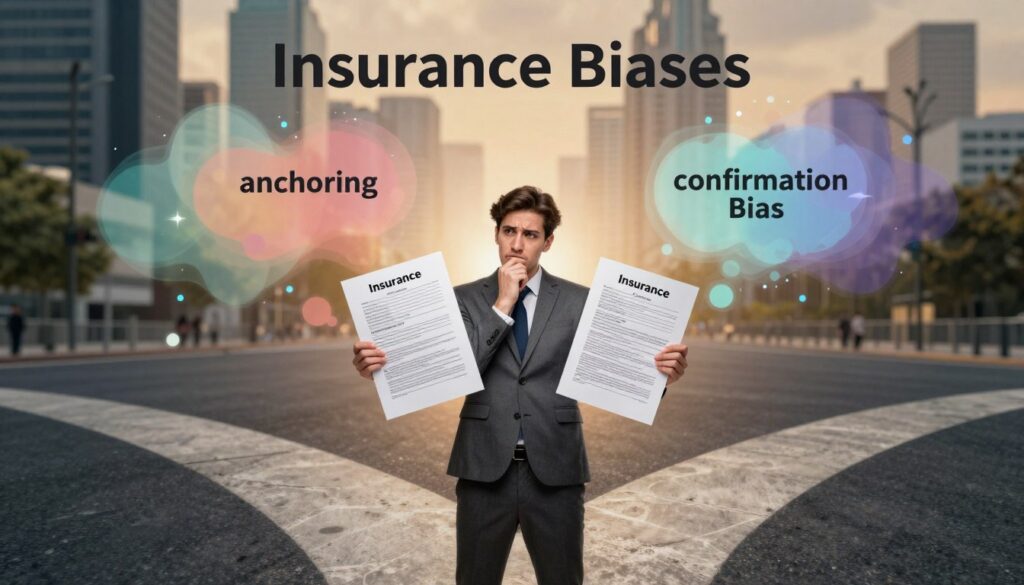
Anchoring Bias: The Impact of First Impressions
Initial information creates powerful reference points that shape subsequent judgments. This anchoring effect strongly influences insurance perception.
When providers present high premiums first, lower options appear more reasonable. This strategic sequencing leverages our tendency to rely heavily on early data points.
The first figure encountered becomes a mental benchmark. Subsequent offers are evaluated against this anchor rather than objective value.
Loss Aversion and the Fear of Potential Losses
Loss aversion represents a fundamental driver in protection decisions. Research shows people feel potential losses about twice as intensely as equivalent gains.
This powerful aversion to loss creates disproportionate anxiety about being unprotected. Even low-probability events trigger strong emotional responses.
The fear of financial devastation often outweighs rational cost-benefit analysis. This explains why comprehensive coverage appeals despite statistical unlikelihood.
Small risks framed as potential losses receive excessive attention. Meanwhile, genuinely catastrophic threats may be underestimated due to psychological distance.
Social Proof and Immediate Emotional Responses
When uncertainty arises, individuals instinctively look to their peers for guidance on coverage. This natural tendency to follow collective wisdom plays a significant role in how people make protection choices.

The decision-making process often involves seeking validation from others within social networks. People find comfort in knowing their insurance decisions align with what others are doing.
Falling in Line: The Role of Social Influence in Decision-Making
Social proof becomes especially powerful when facing complex insurance options. Many people lack confidence in evaluating technical information independently.
Seeing friends or family members purchase specific coverage serves as implicit endorsement. This observed behavior significantly influences similar choices among peers.
In today’s connected world, social validation extends beyond immediate circles. Online reviews and community discussions shape perceptions across broader populations.
The human mind finds psychological comfort in following established patterns. This collective wisdom reduces anxiety associated with complex protection decisions.
Understanding this social behavior reveals why community-focused marketing often succeeds. Peer validation frequently outweighs purely factual approaches to insurance education.
Challenges in Assessing Risk and Making Informed Choices
A fundamental paradox defines how many individuals approach safeguarding their assets. People often prioritize minor, manageable threats while neglecting significant, life-altering dangers.
Ambiguity Aversion and the Over-Insurance of Small Risks
This behavior is partly driven by ambiguity aversion. People prefer known costs over uncertain scenarios, even when the uncertain option offers better value.

A 2019 study highlights this clearly. UK adults were twice as likely to insure their pets than to secure income protection. The predictable premium for pet coverage feels more manageable than the complex probability of losing one’s income.
This aversion leads to over-insuring small risks like phone damage or rental car excess. Meanwhile, critical health or long-term financial threats receive insufficient attention.
Present Bias: Prioritizing Immediate Gratification Over Future Security
Another major hurdle is present bias. This tendency makes people prioritize immediate gains over future security. The monthly cost of a policy feels like a loss today, overshadowing the potential future benefit.
Researchers note that people often postpone evaluating essential life or health policies. They choose more gratifying activities instead of planning for long-term protection.
This bias explains why sound long-term investments in coverage are frequently delayed. The immediate comfort of spending money elsewhere often wins.
Conclusion
Cognitive patterns significantly influence how we approach financial security decisions. Our mind often relies on emotional shortcuts rather than statistical analysis when evaluating protection needs.
The gap between perception and reality drives many puzzling insurance choices. People frequently over-protect against vivid but minor threats while neglecting significant life risks.
Understanding these psychological factors helps improve decision-making. By recognizing common biases, people can make more rational insurance decisions aligned with actual needs.
This awareness transforms how we approach protection throughout life. It enables better evaluation of true risks versus perceived threats in the insurance selection process.